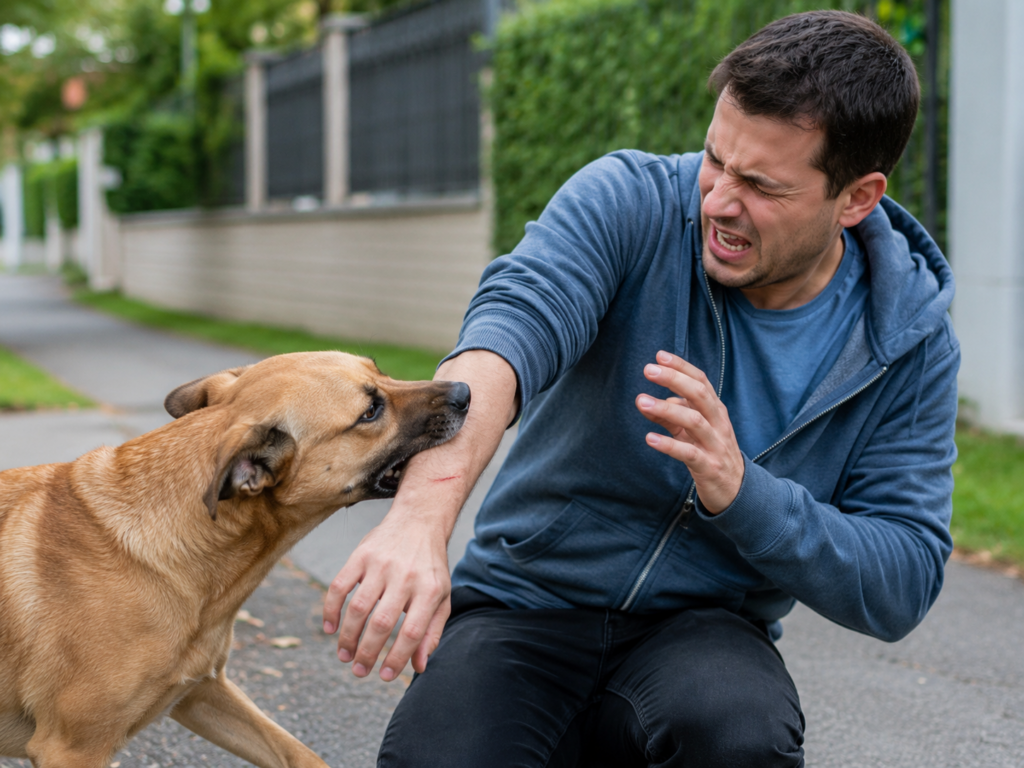
Yes, it does, most of the time. If the dog that bit you belongs to somebody who rents, that renters policy is probably where your money is coming from, and most victims never think to ask about it. They figure a renter has nothing worth going after. Or they figure their health insurance is the only option, so the bills get absorbed quietly by the person who got bitten, while a company that was contractually on the hook the whole time pays nothing. Forty years of doing this and we still see that exact outcome every month.
The problem with “yes, it’s covered” is everything hiding behind the yes. The breed of the dog. Where the bite happened. Whether the owner ever mentioned a dog on the insurance application, whether the dog had bitten someone before. Any one of those can flip the answer to no, or at least shrink the offer down to a number that won’t clear the emergency room bill, and the adjuster is under no obligation to explain which exclusion they’re leaning on until you push.
What follows is how the coverage actually works, what it excludes, how Florida and Ohio treat the same bite differently, and what to do next. Owner or victim, the advice at the end is the same, don’t sign anything before a free consultation.
The short answer
A standard renters policy carries two coverages that matter here. Personal liability is the big one, it pays other people when the policyholder is legally responsible for hurting them, and a dog bite sits squarely inside that. Limits run from $100,000 to $300,000 on most policies, and plenty of renters carry the bare hundred thousand because nobody upsells a renters policy, it’s the insurance people buy because a landlord made them.
The second coverage is medical payments to guests. A small no-fault pot, usually $1,000 to $5,000, that pays a bitten guest’s bills without anyone having to prove the owner did anything wrong. It handles stitches and an urgent care visit and not much past that.
Personal liability is where real compensation lives. It pays the victim’s medical bills, lost wages, pain and suffering, and in the bad cases future treatment, and it also pays the dog owner’s legal defense if the claim turns into a lawsuit. Owners are usually surprised by that last part. They assumed being sued meant hiring a lawyer out of pocket. It doesn’t, their insurer hires the defense and pays for it, which is one more reason the policy matters to both sides of the bite.
Medical payments coverage was not put in the policy out of generosity. It exists, at least in part, so the insurer can close out a small injury fast, before the injured person finds out what the liability side of the same policy would have paid.
So far, good news. The next section is about the money. The two after it are about the several ways the money disappears.
What the policy actually pays, and how much
The list of what counts as damages runs longer than most victims assume. Emergency room care and every follow-up visit, obviously. Plastic surgery for scarring, and that includes revision surgery years later, which matters enormously with child victims because a child’s scar changes as the child grows. Lost wages. Pain and suffering, frequently the single largest piece of a serious bite case. And in the severe ones, future medical costs and long-term therapy, because a kid who got mauled does not stop being terrified of dogs when the stitches come out.
On size, insurers paid out $1.86 billion across 28,450 dog-related injury claims in 2025 per the Insurance Information Institute, which works out to $65,450 average per claim, and that average is being dragged down by thousands of small claims settled at the med-pay limit. Severe attacks clear $100,000 routinely, some blow past the policy limit altogether. Florida ranked second in the whole country by claim volume last year, which will not surprise anyone who practices here. Ohio ranked fourth.
Dog Bite Insurance Claims by the Numbers
Now the part no adjuster volunteers. The first offer is not the value of the claim. The first offer is a number designed to look reasonable to someone staring at an ER bill, and it almost never accounts for scarring, future treatment or pain and suffering at all. We wrote about how those negotiations actually go in how Podor Law fights for dog bite victims, the short version being that the number in the first letter is a starting position, not a valuation, and the insurance company knows the difference even when the victim doesn’t.
What’s not covered is where victims lose money
Every denial we see traces back to a short list of exclusions, so it’s worth reading the whole list before an adjuster recites part of it at you.
- Bites to people who live in the same household. If your roommate’s dog bit you, or the family dog bit your child, the renters policy pays nothing at all. Health insurance has to absorb it. This one feels unjust, and it is how every standard policy is written anyway.
- Excluded breeds. Big enough that it gets its own section below.
- Dogs the insurer was never told about. A renter who skipped the pet question on the application, or answered it dishonestly, handed the company a reason to deny the whole claim.
- Dogs with a bite already on record. One documented bite and most carriers either exclude that animal going forward or just decline to renew.
- Bites away from the home. Varies by policy, honestly. Liability coverage generally follows the policyholder, so a bite at the park is often covered, but the guest medical portion is frequently limited to the premises, and some policies restrict off-premises animal liability outright. Nobody knows until the policy itself gets produced, and the insurer is in no hurry to produce it.
- Everything above the limit. Damages of $250,000 against a $100,000 policy means the policy stops at a hundred thousand and the rest becomes a claim against the owner personally.
A coverage denial is, technically speaking, a dispute between the insurance company and its own policyholder. The dog owner’s legal responsibility to the victim does not go anywhere. Only the source of payment changes, which is why a denied claim is the beginning of a different case, not the end of the original one.
That point gets missed constantly, at least in the cases that reach us after the victim gave up once already. When the policy won’t pay, the owner still owes. Recovery can come out of the owner’s assets, out of an umbrella policy the owner forgot existed, and in some situations out of a landlord who knew a dangerous dog was living on the property and did nothing. Harder collections, all of them. Not dead ends.
Why does the breed of the dog decide whether anyone gets paid?
Because insurers price risk off claims data, and their data says certain breeds produce more frequent and more expensive claims. Whether that reflects the dogs or the owners is a debate we’re going to stay out of, the lists exist either way. A Forbes Advisor review of dozens of carriers’ underwriting filings found pit bulls (a label insurers stretch to cover American Staffordshire and Staffordshire bull terriers), rottweilers, Doberman pinschers, German shepherds, akitas, chow chows, mastiffs, Great Danes and wolf hybrids among the most commonly banned. A few carriers, State Farm is one, don’t ask about breed at all and judge the individual dog’s history instead. So the same bite can be fully covered under one company’s paper and flatly excluded under another’s, which is an odd way to run a compensation system, and it is the system.
Five states have banned breed-based underwriting by insurers: Nevada, New York, Colorado, Illinois and Minnesota, Minnesota’s version being narrower than the rest. Florida and Ohio are not on that list. Carriers in both states can write breed exclusions into renters policies and they do. Florida did pass the Pam Rock Act, effective July 1, 2025, but that law works the other direction, it requires owners of dogs formally classified as dangerous to carry at least $100,000 in liability insurance. Ohio has imposed a similar requirement on owners of dogs designated vicious for years. Both rules can put money on the table even where a renters policy excluded the breed.
A breed exclusion does not end the case, by the way. It removes the easiest payer and pushes the claim onto the harder paths described above. Owners wanting to understand their own exposure should read our piece on whether you can go to jail if your dog bites someone, because the criminal side is a separate problem from the insurance side and neither one waits for the other.
If a breed exclusion, or any exclusion, has already been waved at you, that is exactly what a free consultation is for. Bring the denial letter. We have read hundreds of them.
Florida, Ohio, and everywhere else
State law decides what the insurance company owes, whatever the adjuster says about the policy. The same bite is worth different amounts, on different deadlines, depending on which side of a state line it happened.
Florida
Florida is a strict liability state under Florida Statute 767.04. The owner of a dog that bites someone in a public place, or lawfully on private property, is liable for the damages regardless of whether the dog had ever shown aggression before. For victims this is a large advantage, the insurer cannot argue the owner had no way of knowing the dog was dangerous, that defense does not exist under the statute. The victim’s own carelessness can reduce the recovery proportionally, and a properly posted “Bad Dog” sign gives owners a partial defense, though not against children under six.
Deadlines got shorter recently and a lot of older articles haven’t caught up. Since March 24, 2023, negligence claims in Florida must be filed within two years, cut from four by the state’s tort reform law. Claims brought purely under the strict liability statute may sometimes have a longer window, a distinction worth exactly one conversation with a lawyer and zero attempts to figure out on your own. Our Bradenton office handles these cases across the state.
Ohio
Ohio gives victims two separate routes and lets them run both at once, the Ohio Supreme Court confirmed as much in Beckett v. Warren. Route one is the strict liability statute, Ohio Revised Code 955.28, which makes the owner, keeper or harborer of a dog liable for any injury it causes, unless the victim was trespassing, committing a crime, or tormenting the animal. Route two is the old common-law “one-bite” rule, a negligence theory requiring proof that the owner knew the dog was dangerous, and it opens the door to damages the statute handles less generously, punitive damages in particular. That negligence route runs on the ordinary framework we broke down in the four elements of negligence.
Deadlines here are strange. Negligence claims carry Ohio’s standard two-year limit for bodily injury, while a claim brought under the statute may fall under a six-year window for liabilities created by statute. Which theory gets pled controls which clock applies, so a decision made in the first week of the case matters years later. Our Solon office has been making that call for Ohio bite victims for decades.
The rest of the country
Most states now follow strict liability in some form. A shrinking minority still runs the pure one-bite rule, where the victim has to prove the owner knew the dog was dangerous before anybody owes a dollar. The policy language matters far less than people assume, the law tells the insurer what its policyholder owes and the policy just says how much of it the insurer will fund.
Dog Bite Law: Florida vs. Ohio
| Florida | Ohio | |
|---|---|---|
| Liability rule | Strict liability under Fla. Stat. 767.04, regardless of the dog’s history | Strict liability under ORC 955.28, plus a parallel common-law negligence claim |
| Filing deadline | 2 years for negligence claims (post-March 2023); statutory claims may allow longer | 2 years for negligence; up to 6 years for the statutory claim |
| Breed exclusions by insurers | Permitted | Permitted |
| Special insurance rule | Pam Rock Act (2025): owners of dogs classified as dangerous must carry $100,000+ in liability coverage | Owners of dogs designated vicious must carry $100,000 in liability coverage |
| 2025 claim average | $62,375 across 2,347 claims | $41,413 across 1,348 claims |
Strict liability does not make the insurance company pay faster. It changes what the argument is about. The insurer stops disputing whether it owes and starts disputing how much, and that second fight is quieter, slower, and easier for a victim to lose without ever noticing a fight was happening.
How to file the claim, step by step
- Get medical care the same day. Roughly 20% of dog bite wounds get infected, and emergency physicians recommend being seen within eight hours. That visit’s record also becomes the foundation of the whole claim, a cold way to think about a wound, and true anyway.
- Report the bite. In Florida to the county health department, in Ohio to the local health commissioner, generally within 24 hours. Reporting is legally required most places. It triggers a rabies quarantine of the dog and it creates an official record of when and where the bite happened.
- Identify the owner and ask for their insurance information. Renters insurance specifically. Many owners genuinely do not know their policy covers this, ask for the carrier name and let the adjusters sort out the rest.
- Document everything. Photos of the injury as it heals, the dog if that’s safely possible, the scene, contact information for anyone who saw it. Keep the torn clothing.
- File the claim, or have a lawyer file it. The claim goes to the owner’s carrier, not yours, and how it gets framed on day one, which statute, which damages, affects everything downstream.
- Do not take the first offer and do not give a recorded statement. The recorded statement exists to lock you into answers before you know what the injury is worth. Decline politely until you’ve talked to an attorney.
When a lawyer earns the fee
Some bite claims resolve fine without us. Small injury, cooperative carrier, no scarring, we won’t pretend otherwise. Representation stops being optional, in our view, when any of the following shows up: a denial built on a technicality like breed or an undisclosed dog, an offer that doesn’t clear the medical bills, permanent scarring or disability, a child victim, or a dog with prior attacks. Those cases turn on coverage and valuation arguments the insurance company keeps full-time staff for, and you don’t.
Even the small case deserves one free phone call though, because the most common mistake we see isn’t losing a fight. It’s accepting a number without knowing what the claim was worth, because nobody told the victim that scarring, revision surgery and pain and suffering were compensable at all. Said differently, the offer in front of you can be fair or it can be a fraction of fair, and from the outside those two letters look identical. The consultation costs nothing and representation costs nothing unless we recover, a structure we explained in how much a personal injury lawyer costs. More about us on the why hire us page.
The bottom line
Renters insurance usually covers dog bites, with $100,000 to $300,000 in liability limits standing behind most claims, and an exclusion list long enough that “usually” is doing heavy lifting in that sentence. Household members are out. Certain breeds are out with most carriers in Florida and Ohio. Undisclosed dogs and repeat biters hand the insurer a door, and adjusters open every door they’re handed. What no exclusion changes is that the owner owes the victim under both states’ strict liability statutes, the only real question is where the money comes from.
If a dog bit you or your child, do not negotiate with the owner’s insurance company alone, they resolve thousands of these claims a year and you will resolve one. Podor Law has spent more than 40 years getting bite victims paid fairly from our offices in Bradenton, Florida and Solon, Ohio, and we don’t get paid unless you do. Contact us for a free consultation before you sign anything.
Sources
- Florida Statute 767.04, Damage by dogs; liability of owners. Florida Legislature. http://www.leg.state.fl.us/statutes/index.cfm?App_mode=Display_Statute&URL=0700-0799/0767/Sections/0767.04.html
- Florida Statute 95.11, Limitations other than for the recovery of real property (two-year negligence deadline, as amended March 2023). Florida Legislature. http://www.leg.state.fl.us/statutes/index.cfm?App_mode=Display_Statute&URL=0000-0099/0095/Sections/0095.11.html
- HB 593, Dangerous Dogs (the Pam Rock Act), 2025 session. Florida House of Representatives. https://www.flhouse.gov/Sections/Bills/billsdetail.aspx?BillId=81065
- Ohio Revised Code 955.28, Dog may be killed for certain acts; owner liable for damages. Ohio Legislature. https://codes.ohio.gov/ohio-revised-code/section-955.28
- Ohio Revised Code 2305.10, Bodily injury or injury to personal property. Ohio Legislature. https://codes.ohio.gov/ohio-revised-code/section-2305.10
- Ohio Revised Code 2305.07, Contract not in writing; liability created by statute. Ohio Legislature. https://codes.ohio.gov/ohio-revised-code/section-2305.07
- Beckett v. Warren, 124 Ohio St.3d 256, 2010-Ohio-4. Supreme Court of Ohio. https://www.supremecourt.ohio.gov/rod/docs/pdf/0/2010/2010-ohio-4.pdf
- Spotlight on: Dog bite liability. Insurance Information Institute, updated April 2026. https://www.iii.org/article/spotlight-on-dog-bite-liability
- Banned dog breed lists by home insurance companies. Forbes Advisor. https://www.forbes.com/advisor/homeowners-insurance/banned-dog-breed-lists/
- Ending breed-specific insurance discrimination. ASPCA. https://www.aspca.org/improving-laws-animals/public-policy/ending-breed-specific-insurance-discrimination
- What is medical payments coverage? Policygenius. https://www.policygenius.com/homeowners-insurance/what-is-medical-payments-coverage/
- Does renters insurance cover pets and pet damage? Progressive. https://www.progressive.com/answers/does-renters-insurance-cover-pets/
- Does renters insurance cover medical bills? Allstate. https://www.allstate.com/resources/renters-insurance/renters-insurance-medical-bills
- If a dog bites you, do these things now. Cleveland Clinic. https://health.clevelandclinic.org/if-a-dog-bites-you-do-these-7-things-now
- Management of bite wounds and infection in primary care. Cleveland Clinic Journal of Medicine. https://www.ccjm.org/content/ccjom/64/3/137.full.pdf
- Report an animal bite. Florida Department of Health. https://hillsborough.floridahealth.gov/programs-and-services/environmental-public-health/animal-bites-and-scratches/report-an-animal-bite/
