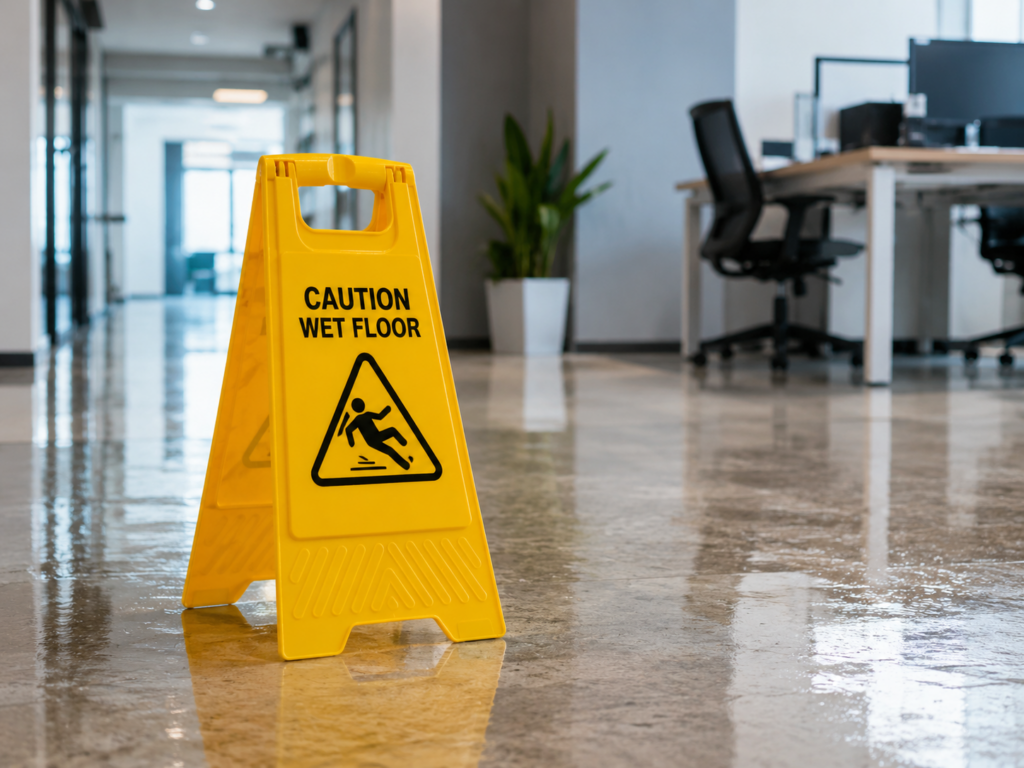
Probably not. Most people asking this question are hoping for a different answer, and they deserve the real one before anything else. If the fall happened at work, workers’ compensation is very likely the only remedy you have against your employer. How wet the floor was doesn’t change that, and neither does the fact that somebody reported the spot twice the week before. The law took that particular lawsuit off the table around a hundred years ago, for everybody, and courts have held the line ever since.
The rule is not the whole story, though. There are a few situations where a lawsuit against the employer does survive, narrow ones but real. And beyond those there is a second kind of case, against people who are not your employer at all, that pays for everything comp will not. Pain and suffering included. Most injured workers never hear about that second kind of case, and in many files it accounts for the larger share of the recovery.
Workplace Falls by the Numbers
The short answer is usually no
Workers’ comp is a trade, and an old one. Most states made it back in the 1910s. You gave up your right to sue your employer over a workplace injury, and in return your employer pays for the injury automatically, without you having to prove that anybody did anything wrong. The legal name for this is the exclusive remedy doctrine. Florida has it written into Fla. Stat. § 440.11, the employer’s liability under comp is “exclusive and in place of all other liability,” those are the statute’s words. Ohio has a version. Almost every state has a version.
What that means for a slip and fall is worth spelling out. Wet floor, no sign, two coworkers complained about that exact spot the week before, and none of it produces a lawsuit against your employer, because ordinary negligence is the exact thing the system was built to absorb. A Congressional Research Service report lays the arrangement out plainly. Workers receive defined benefits without regard to fault, and in exchange they are prohibited from suing their employers.
Whether it was a good trade is a longer conversation. Before comp existed, an injured worker collected nothing unless he won a negligence suit first, and employers in that era had defenses that made winning close to impossible, so guaranteed payment solved a real problem. It solved that problem by paying less than a lawsuit pays, though, and the difference is worth measuring.
What comp pays for, and what it never will
The system does cover real costs, and every dollar of them should be claimed. Medical care is covered in full, the doctor visits, the surgery if one is needed, prescriptions, physical therapy, with no deductible taken out of any of it. Lost wages get partially replaced. In Florida the check is 66 2/3 percent of your average weekly wage and the temporary checks stop at 104 weeks, per the Florida Division of Workers’ Compensation. Ohio starts at 72 percent of your full weekly wage for the first twelve weeks, then drops to two-thirds (Ohio BWC publishes the rate tables each year). The two-thirds figure repeats across the country because 36 states adopted the same formula, according to a Social Security Administration review. The checks are tax free, which softens the reduction without eliminating it.
Comp will also pay for vocational rehabilitation if you cannot return to the same job, permanent disability benefits when the impairment does not resolve, and death benefits to the family when a fall proves fatal, which happened 844 times in 2024 per the BLS census of fatal work injuries. The overall cost of workplace falls runs around $70 billion a year in comp and medical expenses, going by NIOSH’s estimate. Our guide on whether you get paid if you’re injured at work covers the wage-check mechanics in more detail than there is room for here.
The second list is shorter. Pain and suffering, comp pays nothing for it, in any state. The third of your paycheck the formula does not replace stays unreplaced. Loss of enjoyment of life is not a category the system recognizes, and punitive damages are not available within it. There is also a fair argument that the system underdelivers even on its own terms. A Department of Labor review concluded that indemnity benefits are inadequate in “many, perhaps most” jurisdictions.
Researchers writing in the American Journal of Industrial Medicine followed injured workers for the ten years after their injuries and found the workers lost around 15 percent of their earnings over that stretch. Comp benefits replaced 16 percent of what was lost. That’s 16 percent of the losses themselves, to be clear, not of the wage. Whatever a lawsuit is worth to an injured worker, it lives somewhere in that gap.
Workers’ Comp vs. a Personal Injury Lawsuit
| Type of Loss | Workers’ Compensation | Personal Injury Lawsuit |
|---|---|---|
| Medical treatment | Covered – authorized care, no deductible | Covered – past and future care |
| Lost wages | Partial – roughly two-thirds, capped by state maximums | Full – including future earning capacity |
| Pain and suffering | Never | Recoverable |
| Loss of enjoyment of life | Never | Recoverable |
| Punitive damages | Not available | Possible in cases of egregious conduct |
| Proof required | None as to fault – injury must be work-related | Negligence must be proven against the defendant |
| Who pays | Employer’s insurance (or the state fund in Ohio) | Third parties – the employer only in narrow exceptions |
A lot of workplace falls never need surgery, and a small injury tends to get read as a small case. Our breakdown of slip and fall settlements without surgery explains why that assumption costs claimants money.
When you CAN sue your employer
The exceptions are narrow, we want to be honest about that up front, and all of them turn on facts nobody can evaluate from an article.
Start with the employer that never bought the insurance. Coverage is mandatory in Florida for most businesses, four or more employees in most industries, one is enough in construction, and still some small operations go without, illegally, more often than most people assume. Section 440.11(1)(a) handles the situation bluntly. An uninsured employer loses the exclusive remedy protection altogether. You can take them to civil court for full damages, and the statute will not let them argue that a coworker caused the fall or that you assumed the risk. It was written to make operating without insurance costly, and it does.
The other route is intentional harm, and the bar sits high. Florida wants clear and convincing evidence that the employer either meant to injure you or knew, from earlier similar accidents or explicit warnings, that injury was “virtually certain” and hid the danger from you anyway. Ohio’s statute is Ohio Revised Code § 2745.01, deliberate intent to injure is the requirement there, though it has one feature worth knowing about. If the employer deliberately removed a safety guard from a piece of equipment, or misrepresented a toxic substance, the law presumes the intent and puts the burden on the employer to disprove it.
One odd thing about Ohio’s statute deserves a second read. The text says an employer is liable when injury was “substantially certain” to occur, then in the next subsection it defines “substantially certain” as meaning “deliberate intent to injure.” The wider standard got folded into the narrower one, deliberately, and the Ohio Supreme Court upheld the arrangement in Kaminski v. Metal & Wire Products back in 2010. A legislature writes a statute that way when it wants an exception that hardly anyone gets through.
A handful of states allow suits for gross negligence, meaning recklessness bad enough to start resembling intent. Florida is not one of them and neither is Ohio. Defective equipment and toxic exposure come up in these conversations often as well, and those facts usually point away from the employer, toward a manufacturer, where the case tends to be stronger anyway.
Third-party lawsuits, the claim most injured workers never hear about
Take a delivery driver who slips on an unmarked wet floor inside a customer’s store. Against her own employer, comp is the limit, everything above applies. The store is a different matter. Against the store she has an ordinary premises liability case, the same one any customer who slipped there would have, and pain and suffering comes back into the picture, so do full lost wages and future losses. The exclusive remedy doctrine shields employers. The store was never her employer.
Once you see the pattern it shows up everywhere. Construction workers hurt on land their employer doesn’t own. Service techs, home health aides, delivery crews, really anybody whose job puts them on somebody else’s floor. A defective ladder or a bad floor machine points at the manufacturer, that’s product liability, and Ohio’s § 2305.10 expressly contemplates those claims. An outside cleaning company that left the hazard can be sued for its own negligence, separate from anything involving your employer. Construction sites produce these cases constantly, ten companies on one job, and one subcontractor’s carelessness is all it takes.
You do not have to choose between the two. The comp claim and the lawsuit run at the same time, and filing one does not waive the other. What the comp carrier does receive is a lien on part of whatever the lawsuit brings in, reimbursement for some of what it already paid you. Clients rarely welcome the lien when it comes up, understandably. It proves something useful, though.
Think about what the lien actually tells you. The comp system has repayment machinery built into it, machinery that only makes sense if the law expected, from the beginning, that injured workers would be collecting from a lawsuit and from comp at the same time. If comp was supposed to be the whole recovery, none of that would need to exist.
What do these cases pay? It depends on the facts, but our collection of slip and fall settlement examples gives a realistic range for premises claims.
Florida, Ohio, and everywhere else
Florida
Coverage requirements first, since the uninsured-employer exception depends on them. Four or more employees for most industries, one or more in construction, and in agriculture it’s six regular workers or twelve seasonal (Florida DWC has the full breakdown). The intentional tort exception exists here, but Florida courts read it narrowly and always have. The deadline deserves the most attention. Two years from the date of the fall for any personal injury claim, third-party claims included, under Fla. Stat. § 95.11. It was four years until the legislature shortened it. Anything that happened on or after March 24, 2023 gets the two-year window, and many people remain unaware of the change. Our Florida office in Bradenton handles both the comp side and the injury side.
Ohio
Comp here runs through a state fund, the Bureau of Workers’ Compensation, not through private insurers, which changes the administration but not the underlying trade. The intentional tort statute is the § 2745.01 covered above. What Ohio has that Florida doesn’t, and what few claimants have heard of, is the VSSR, violation of a specific safety requirement. Where the employer broke a specific safety rule in the state administrative code and the violation caused the injury, an application goes to the Ohio Industrial Commission and the award, if granted, adds 15 to 50 percent of the maximum weekly rate on top of the regular benefits, paid by the employer directly. Not a lawsuit, it stays inside the comp system, but it is real money and it goes unclaimed far more often than it should. The personal injury deadline is two years here as well, Ohio Revised Code § 2305.10. Our Ohio office is in Solon and covers Northeast Ohio.
The rest of the country
A fifty-state survey is beyond what this article can do, and the summary is short anyway. The doctrine is nearly universal, the exceptions are not, deadlines run anywhere from one year to six, and the lien rules change at every state line. The rules that govern your case are the ones in the state where you fell, which makes an attorney licensed there the one part of this that is not optional.
What to do in the first week
- Report the fall to your employer, in writing. Florida’s notice window is 30 days, per the state’s own guidance for injured workers, and it closes faster than people expect. An email counts. Send it the same day if you can.
- Get seen by a doctor even if you feel fine. Back and neck injuries, head injuries especially, can take days to announce themselves, and the medical record from day one will do more for your claim than anything created in week six.
- Photograph the scene while it still exists. The spill, the broken step, the spot where a warning sign should have been. OSHA’s walking-working surfaces rule requires employers to correct hazards before the surface is used again, which protects workers and also means the evidence tends to be cleaned up within hours. Collect names and phone numbers of anyone who saw the fall as well.
- File the comp claim. It is the baseline path, and filing it waives nothing.
- No recorded statements to the insurer until you’ve talked to a lawyer. Recorded statements exist so claims can be trimmed later. That is their function, regardless of how the conversation feels.
- Ask any lawyer you talk to whether they handle personal injury or only comp. A comp-only practice can process your claim correctly and still miss a third-party case worth several times the benefits, and the miss does not show up until the two-year clock has already run.
For the prevention side of the topic, our post on avoiding slips, trips and falls at work covers workplace practices in more detail.
Why the free consultation is worth an hour of your time
Taken together, there are at least four possible paths. Comp by itself, comp plus a third-party lawsuit, a direct suit under one of the exceptions, a product claim against a manufacturer. Plenty of falls open two or three of them at once. Which ones apply to yours depends on facts no article can reach, who owned the floor, what made it slick, whether your employer carried a policy, what other companies were working that site the same week. Those questions get answered in a conversation, with the details of your case in front of someone qualified to read them.
Podor Law handles workers’ compensation and personal injury under one roof, in Ohio and in Florida, so every path gets evaluated in the same conversation instead of a comp file moving forward while a premises claim sits unexamined, running out of time. More about how we work is on the site. The consultation is free, the fee is contingent, and you pay nothing unless we recover for you.
The bottom line
Can you sue your employer for a slip and fall at work? Usually no. The trade behind that answer is a century old and it holds. But usually no is not the same as nothing left to recover. Comp on its own leaves the pain and suffering unpaid, leaves a third of every paycheck unpaid, and in a surprising number of files there is a third-party claim nobody ever opened. Call our Ohio or Florida office, or reach us online. The conversation costs nothing, and you owe nothing unless we win.
Sources
- Florida Legislature, Florida Statutes § 440.11, Exclusiveness of Liability
- Florida Legislature, Florida Statutes § 95.11, Limitations
- Florida Division of Workers’ Compensation, Injured Worker FAQs
- Florida Division of Workers’ Compensation, Employer Coverage Requirements
- Ohio Legislative Service Commission, Ohio Revised Code § 2745.01
- Ohio Legislative Service Commission, Ohio Revised Code § 2305.10
- Supreme Court of Ohio, Kaminski v. Metal & Wire Products Co., 2010-Ohio-1027
- Ohio Bureau of Workers’ Compensation, Types of Benefits
- Ohio Industrial Commission, VSSR Applications
- Congressional Research Service, Workers’ Compensation: Overview and Issues, R44580
- U.S. Social Security Administration, Benefit Adequacy in State Workers’ Compensation Programs
- U.S. Department of Labor, Does the Workers’ Compensation System Fulfill Its Obligations to Injured Workers?
- Boden et al., American Journal of Industrial Medicine, Adequacy of Workers’ Compensation Benefits
- U.S. Bureau of Labor Statistics, Census of Fatal Occupational Injuries, 2024
- U.S. Bureau of Labor Statistics, Survey of Occupational Injuries and Illnesses, Table 2
- CDC / NIOSH, Falls in the Workplace
- OSHA, 29 CFR 1910.22, Walking-Working Surfaces