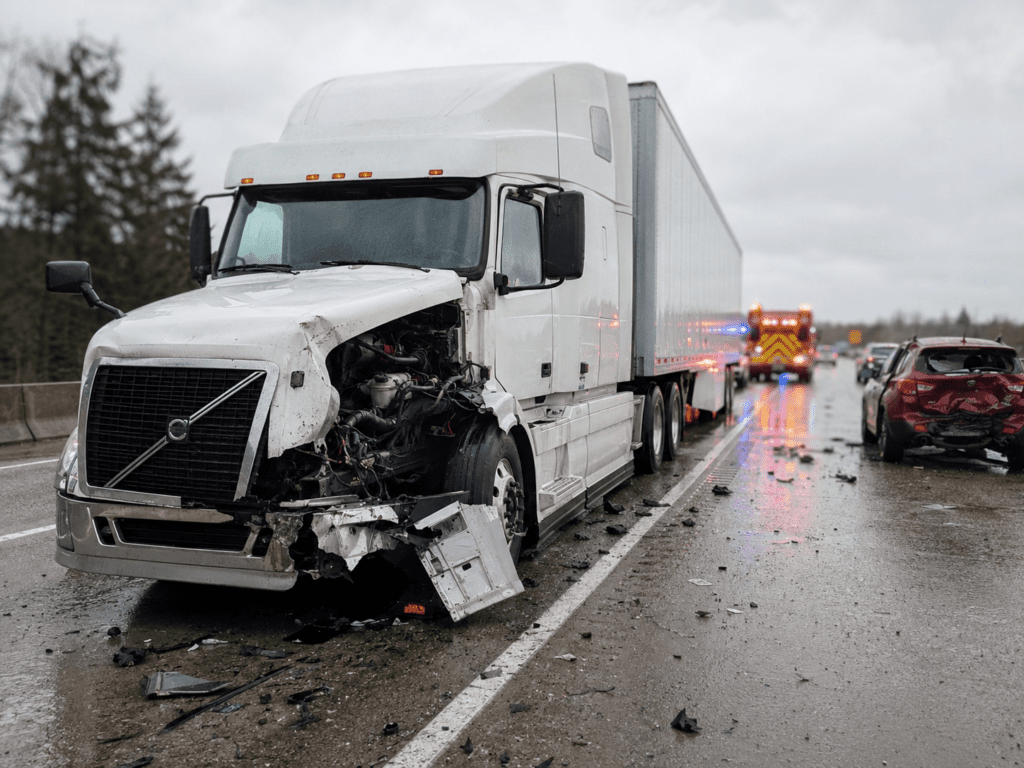
If you have been involved in a truck accident, the first thing you should know is that your situation is far more complex than standard car accidents. The injuries tend to be more severe, the legal questions are harder to answer, and there are almost always more parties at fault than you might expect. At Podor Law, we have seen firsthand how overwhelming this process can be for truck accident victims and their families, and we want to help you understand what you are up against.
Understanding liability in truck accidents begins with a simple physical reality. A fully loaded tractor trailer can weigh up to 80,000 pounds. Your car probably weighs around 4,000. That 20 to 1 weight difference is not just a number. It is the reason why, according to NHTSA’s 2023 large truck data, 70% of the people killed in large truck collisions that year were occupants of the other vehicles, not the truck. The physics alone explain why these cases involve higher medical bills, longer recovery times, and far more complicated legal battles.
But here is what many people do not realize: the truck driver may not be the only one who could be liable. In fact, there could be three, five, or even eight different parties who bear some responsibility for what happened to you. Determining who is liable is not just legal strategy. It is often the difference between a settlement that barely covers your medical expenses and one that actually accounts for the full scope of your losses.
Who Dies in Truck Accidents?
Occupants
Why These Cases Are So Different
When two passenger cars collide, determining who is at fault is usually straightforward. One driver ran a red light, or someone was texting, and fault falls squarely on that individual. A commercial truck accident does not work that way.
Trucking is a heavily regulated industry. The Federal Motor Carrier Safety Administration sets strict rules governing everything from how many hours a driver can be behind the wheel to how frequently brakes must be inspected. When a truck accident occurs, the question is not just “who’s at fault?” but “who else failed in their obligations along the chain?”
There is also the matter of insurance. Federal law requires general freight carriers to maintain a minimum of $750,000 in coverage, and carriers hauling hazardous materials must carry up to $5 million. These numbers are significantly higher than what you see in a typical auto policy, and for good reason. The damage these vehicles can cause is catastrophic. But those higher policy limits also mean that insurance companies fight harder to minimize payouts and shift blame onto the victim.
This is one of the reasons why working with an experienced truck accident attorney is so important. The stakes are higher on every side. If you are unsure where to begin, our car and truck accident page explains how we approach these cases from the very first consultation.
Key Fact: A fully loaded truck requires approximately 600 feet to stop at highway speed. That is roughly the length of two football fields and 20 to 40% more stopping distance than a passenger vehicle.
The Parties Who Can Be Held Liable in a Truck Accident
One of the most important things to understand about determining truck accident liability is that responsibility rarely falls on just one party. Liability can extend from the driver to the trucking company and well beyond. The potentially responsible parties include the truck driver, the carrier, the parts maker, and several others. Here is a closer look at who could be at fault.
The Truck Driver
This is the most obvious starting point. Driver negligence includes speeding, distracted driving, fatigue, and impairment. NHTSA data from recent years shows that speeding remains the leading cited factor in fatal collisions involving large trucks, followed by distraction and careless driving. The FMCSA’s Large Truck Crash Causation Study found that driver related factors were responsible for 87% of incidents where the truck was assigned the critical reason.
But suing only the driver is often a mistake. Most truck drivers carry limited personal assets, and their individual insurance may not come close to covering your damages. A driver may have caused the accident, but that does not mean they are the only responsible party.
What Causes Truck Crashes?
Highest Risk Factors in Truck Crashes
The Trucking Company
This is where things get more interesting from a legal standpoint. Under the principle of vicarious liability, known as respondeat superior, a trucking company may be held responsible for the negligent actions of its employee drivers when those actions occur within the scope of employment. Importantly, federal regulations under 49 C.F.R. § 390.5 define “employee” to include independent contractors while operating a commercial motor vehicle, which effectively closes the loophole that many carriers used to try to avoid accountability.
Beyond that, trucking companies have a responsibility to hire qualified drivers, provide adequate training, and maintain their vehicles. The industry’s driver turnover rate tells a troubling story. According to American Trucking Associations data, large truckload carriers experience an average annual turnover rate of about 93%. That kind of revolving door creates enormous pressure to fill seats quickly, sometimes at the expense of thorough background checks.
FMCSA audits in 2023 found that 94% of audited carriers had at least one violation, and over half had acute or critical violations. These include failures to verify driver qualifications, falsified duty records, and skipped drug testing. When a carrier may have known about a driver’s poor record but put them on the road anyway, the company could be on the hook for the consequences.
94% of audited trucking companies had at least one FMCSA violation in 2023. Over half had acute or critical violations, including falsified duty records and skipped drug testing.
The Truck Manufacturer
When a mechanical failure causes or plays a role in the collision, the manufacturer of the truck or a defective truck component can be held accountable under product liability laws. This does not require proving negligence in the traditional sense. If the product was defective and that defect caused injury, the manufacturer bears responsibility.
Brake failures are a prime example. The Causation Study found that brake problems were present in 29% of the cases it examined, making them the single most common associated vehicle factor. During Brake Safety Week 2025, 15% of inspected trucks were placed out of service for brake deficiencies alone. Tire blowouts are another major concern. When a defective tire caused the truck to lose control or forced the truck to tip over, the parts maker faces strict accountability.
NHTSA issued 1,073 vehicle and equipment safety recalls in 2024, covering more than 29 million vehicles. When a recalled vehicle caused an accident before being repaired, that recall itself serves as an acknowledgment of a known safety defect, strengthening any liability claim against the manufacturer.
Cargo Loaders and Shippers
This one surprises a lot of people, but improperly loaded cargo is among the most dangerous factors in trucking collisions. The Causation Study found that while cargo shift was present in only about 4% of incidents, it carried the highest relative risk of any associated factor at 56.3 times the baseline. To put that in perspective, fatigue carried a relative risk of 8.0.
Truck drivers must check their loads within the first 50 miles of travel and again every 150 miles or 3 hours, whichever comes first. But the company or crew responsible for loading the truck in the first place may share responsibility if improper securement or overloading contributed to the accident. Cargo loaders, freight brokers, and shippers can all be named in a truck accident claim when their failures make a truck more dangerous on the road.
Maintenance Providers and Other Third Parties
The chain of responsibility does not stop with the parties most directly connected to the vehicle. Liability may also fall on third party maintenance shops that many carriers outsource work to. If a mechanic performs substandard work, misses a critical defect during an inspection, or signs off on repairs that were never actually completed, that maintenance provider may be held liable for its role in the collision.
Government entities may be liable if poor road design or failure to maintain road surfaces contributed to the crash. And of course, other motorists on the road may also bear some responsibility if their own actions played a role in what happened.
Who Can Be Liable and Why
| Liable Party | Legal Theory | Common Failures |
|---|---|---|
| Truck Driver | Direct Negligence | Speeding, fatigue, distraction, impairment, HOS violations, failure to inspect |
| Trucking Company | Vicarious Liability / Negligent Hiring | Inadequate screening, poor training, pressure to meet deadlines, deferred maintenance, falsified records |
| Truck / Parts Manufacturer | Strict Product Liability | Defective brakes, tire blowouts, steering failures, faulty coupling devices, recalled components |
| Cargo Loaders / Shippers | Negligence | Overloading, improper securement, unbalanced loads, failure to follow FMCSA cargo rules |
| Maintenance Providers | Negligence | Substandard repairs, missed inspections, falsified maintenance records, failure to detect defects |
| Government Entities | Premises / Sovereign Immunity Exceptions | Dangerous road design, missing signage, failure to maintain road surfaces, work zone hazards |
How Fault in a Truck Accident Is Actually Proven
Proving fault in these cases requires more than eyewitness testimony and a police report. It requires building a factual record that connects specific failures to specific parties.
The legal framework centers on negligence, which has four elements: duty (the defendant owed a duty of care), breach (they violated that duty), causation (the breach caused the harm), and damages (the plaintiff suffered actual losses as a result). In trucking cases, FMCSA regulations establish the standard of care. Any documented violation of those regulations can serve as evidence of breach. In the broadest sense, liability refers to a party’s legal obligation to answer for the harm they caused, and in truck accident lawsuits, that obligation is often shared among several defendants.
The types of evidence that matter most include the truck’s black box data, which records vehicle speed, brake application, throttle position, and engine fault codes in the seconds before impact. Electronic Logging Devices (ELDs), federally mandated since 2019, provide tamper resistant records of driving hours and can reveal hours of service violations. Maintenance records, hiring files, the carrier’s official accident reports, and safety audit histories all play critical roles in determining fault and establishing each defendant’s share of responsibility.
Evidence Alert: Black box data from a truck’s engine control module can be overwritten in as little as 30 days if the vehicle is restarted. Contacting a truck accident lawyer immediately after a collision is critical to preserving this evidence before it is lost.
One thing that makes evidence preservation so urgent is that black box data can be overwritten in as little as 30 days if the truck is restarted. This is why contacting a truck accident lawyer as quickly as possible matters so much. Your attorney can issue a spoliation letter to the carrier, legally compelling them to preserve all relevant data before anything is destroyed.
If you are not sure where to start with finding the right representation, we put together a guide to choosing the best personal injury lawyer that walks through the key factors you should consider.
Connecting Causes to the Right Defendants
How liability is determined in truck accidents often comes down to tracing what went wrong back to the party whose failure made it possible. Different causes point to different defendants.
Driver fatigue and hours of service violations point to both the driver or trucking company, depending on the circumstances. During the 2024 CVSA International Roadcheck, hours of service was the number one driver violation category, accounting for 32.1% of all driver violations. When a truck driver exceeds the legal 11 hour driving limit, both the individual and the company that pressured or allowed those violations can be found to be at fault.
Mechanical failures redirect the question toward the carrier, the maintenance provider, or the manufacturer depending on the root cause. If brake failure resulted from deferred maintenance, the carrier is at fault. If it stemmed from a manufacturing defect, the parts maker bears responsibility. Liability may be shared across multiple parties when more than one failure contributed to the same outcome.
Improperly loaded freight shifts responsibility to the loading company, the shipper, or both. When the crew that loaded the freight failed to secure it properly and that load shifts during transit, causing the collision, they face direct claims. Even when the accident was caused by a combination of overloading and driver error, each party answers for their share.
The point is that in most cases involving a serious truck accident, responsibility does not rest with a single party. Thorough investigation almost always reveals multiple failures across several entities simultaneously.
Why Identifying All Responsible Parties Matters for Your Compensation
This is not just about legal theory. It has direct financial consequences for every victim.
When multiple parties bear fault, each may carry separate insurance policies. The driver may have personal coverage, the carrier maintains its commercial policy, the manufacturer has its own insurance, and even the maintenance company could be liable for damages through professional coverage. Pursuing all available policies dramatically increases the total compensation available to you.
This matters particularly in Florida, where Podor Law represents clients from our Bradenton office. Florida follows a several liability system where each defendant pays only their proportionate share of fault. If you only name the driver and they are assigned 30% of the fault, you can only recover 30% of your damages from them, even if other parties also bear responsibility. Florida also shifted in 2023 from pure comparative negligence to a modified system with a 51% bar. This means that if you are found to be more than 50% at fault, you recover nothing. These changes directly affect liability determinations and make it critical to identify all liable parties in a truck accident and build the strongest possible record.
Ohio, where our Solon office serves clients, follows a similar modified comparative negligence system. Plaintiffs can recover only if their fault does not exceed 50%. For economic damages, any defendant assigned more than 50% of the fault faces joint and several responsibility for all economic losses, which can be a significant advantage when one defendant is clearly the primary cause.
Florida vs. Ohio: How State Law Affects Your Case
The trend in trucking verdicts also underscores why these claims demand aggressive representation. Research from the American Transportation Research Institute found that the median nuclear verdict (awards exceeding $10 million) reached $36 million in 2022. Factors like substance abuse by the driver increased awards by 341%, and evidence of improper hiring practices pushed awards up by 272%. These numbers reflect juries holding carriers accountable for the systemic failures that put dangerous vehicles and unqualified drivers on public roads.
How a Skilled Truck Accident Attorney Uncovers Every Source of Responsibility
Establishing who bears responsibility is not something that happens automatically. A thorough investigation is what separates accident claims that settle for the minimum from those that capture the full extent of a victim’s losses. Truck accident liability isn’t simple, and you need experienced attorneys who know where to look in these cases. At Podor Law, our attorneys work directly with clients to build the strongest possible case from day one.
The investigation process begins with preserving evidence: sending spoliation letters, obtaining black box and ELD data, securing driver qualification files, and gathering maintenance records. From there, we use FMCSA safety records and audit histories to identify regulatory violations that help determine liability. We work with accident reconstruction experts and medical professionals who can connect specific failures to specific injuries.
Because trucking cases often involve multiple defendants, each with their own legal teams and insurance companies, these cases require coordinated negotiation across several fronts simultaneously. Insurance companies are sophisticated. They deploy their own investigators almost immediately after the accident occurred, and their primary goal is to minimize the carrier’s exposure, often by shifting blame onto the victim. In some cases, they will argue the collision was caused by something unrelated to their client entirely.
Roughly 95% of personal injury cases settle before trial, but having the preparation and willingness to go to trial is what creates real leverage in settlement negotiations. Insurance companies know which firms take cases to verdict and which accept whatever is offered. A seasoned attorney experienced in this area of law can make a claim worth significantly more simply by demonstrating a willingness to fight.
Take the First Step
Navigating fault and responsibility after a devastating trucking collision is complex. Multiple parties, overlapping insurance policies, federal regulations, and aggressive defense teams all create a landscape that is very difficult to handle alone. If you or someone you love has been injured, getting the right legal help early in the process is one of the most consequential decisions you will make.
Our team at Podor Law has more than 40 years of combined experience fighting for injury victims in both Florida and Ohio. We work on a contingency fee basis, which means you pay nothing unless we recover compensation for you. Every case begins with a free consultation where we can review the specifics of your situation and help you understand your options.
Contact Podor Law today for a free case evaluation. The sooner you reach out, the sooner we can begin preserving critical evidence and building your case.
Sources: NHTSA Traffic Safety Facts (DOT HS 813 717), FMCSA Hours of Service Regulations, FMCSA Large Truck Crash Causation Study, Cornell Law Institute, American Trucking Associations Driver Turnover Reports, J.J. Keller 2023 FMCSA Audit Review, CVSA 2024 International Roadcheck Results, ATRI Nuclear Verdicts Research (via Commercial Carrier Journal), Bureau of Justice Statistics, Ohio Revised Code §§ 2315.33 and 2307.22, Florida Statutes § 768.81.

