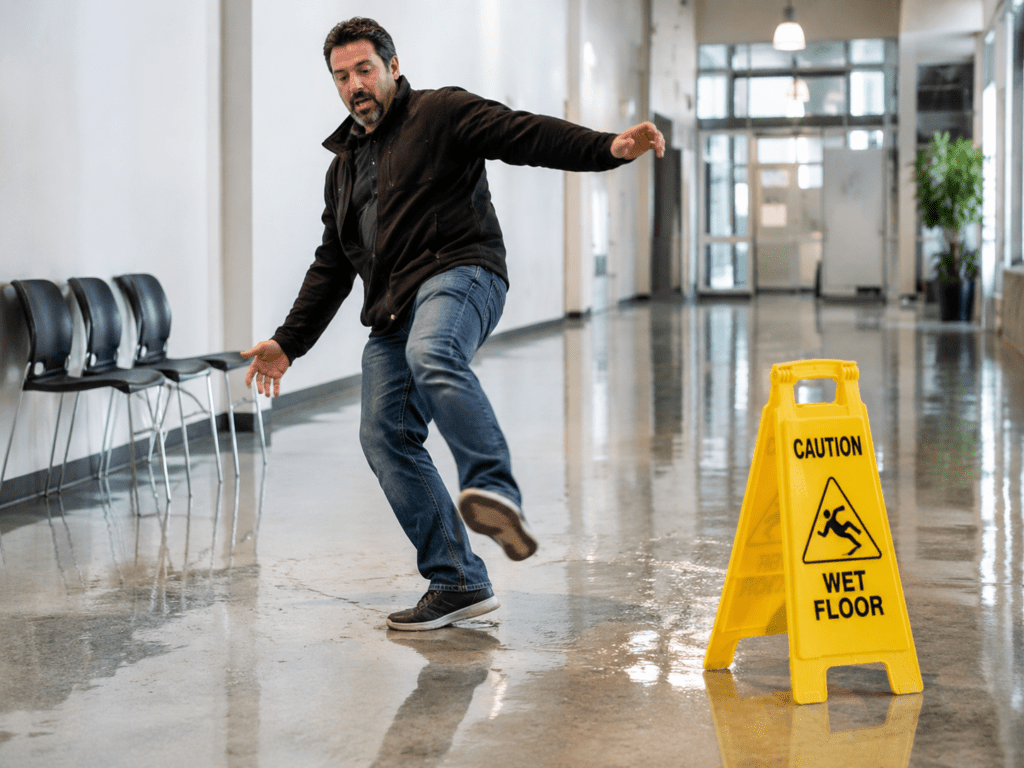
Yes. If a property owner’s carelessness is what made you fall and get hurt, you can sue them. That part is simple, and we say so on the phone. The complicated part is everything that comes after the yes, and that is what this page is really about.
Florida changed its rules a few years back, and Ohio has always been a hard state to win these in, so the people who wait too long end up losing cases they would have won before.
When can you actually sue?
Premises liability is the area of law that applies. It sets out when a property owner has to pay for a fall that happened on their property, and the answer is not every fall. People fall for their own reasons all the time, and the owner does not become responsible for that just because the falling happened on their floor.
What the owner owes you is reasonable care. The store, the landlord, the hotel, the restaurant, each of them has to take reasonable steps to keep the place safe and to warn about hazards they know about, or that they should have known about. When that does not happen, and you fall, and the fall is what hurts you, that is negligence.
The amount of care you were owed is something that turns on why you were on the property to begin with. A customer or a business guest is an invitee, and the invitee is owed the most, so a shopper who falls in a grocery store is usually in the strongest position the law offers. A social guest is a licensee and is owed less than that. A trespasser is owed the least, though there are exceptions, the main ones being for children and for dangers the owner created and then hid. Most of the slip and fall clients we take on are invitees.
Slip and Fall Injuries by the Numbers
The size of this gets underestimated. About one in four older adults falls in a year, that is the CDC figure, and falls are now the leading cause of injury death among people 65 and older, which is not a thing an insurance adjuster is going to volunteer. Falls, slips and trips also sit near the top of the fatal workplace injury counts the Bureau of Labor Statistics keeps, construction worst of all. Adjusters treat these as small accidents, and the numbers do not support that.
The four things you have to prove
A slip and fall claim has four elements, and all four have to hold.
The first is duty. The owner has to have owed you one, and for an invitee in Florida or Ohio that duty is to keep the property reasonably safe and to warn about hazards a person would not catch on their own.
The second is breach, which just means the owner failed at the first one. Milk that sat in aisle six for two hours with no cone is a breach. A handrail the building manager knew was broken for a month and left alone is a breach. Ice across an Ohio parking lot the morning after a freeze, with no salt put down before the place opened, is a breach.
Third is causation, and causation is where the insurance company fights hardest. The hazard has to be the thing that hurt you, and not just a hazard that happened to be present while something else hurt you. The medical records from the day you fell do most of the work on this point, which is the reason we push people to get seen the same day rather than later.
Damages is the fourth one. These are losses you can put on paper, the bills and the missed pay and the future treatment and the pain and suffering. A fall with no injury is not a case, however careless the owner was being.
What people slip on
The hazards behind these cases are a fairly short set. Wet floors with no sign on them. Flooring that is uneven, or carpet that is torn. Stairwells and parking lots that are poorly lit. Snow and ice. Sidewalks that are cracked, handrails that are not there. The unremarkable version, a floor somebody mopped and walked away from without a sign, turns up more than people expect.
A case against a Florida business carries an extra requirement, written into § 768.0755. You have to show the business knew about the spill or should have known, and “should have known” comes down to the spill having sat there long enough, or that kind of spill happening there often enough, that a business paying attention would have found it. The argument usually lands on that one question of how long the spill had been on the floor, and the word doing the work in the statute is “constructive.”
Ohio handles snow and ice under what is called the natural accumulation doctrine. For ice that built up naturally the owner generally owes nothing. The way in is unnatural accumulation, water that refroze because a gutter was broken, snow that a plow pushed into a pile, and the like. Ohio landlords carry specific lighting and maintenance duties as well, set out in R.C. § 5321.04, and that statute matters more than it looks like it should, because breaking it can take away a defense that otherwise wins these cases for the owner. More on that defense below.
Evidence, and why the first days matter so much
Most of these cases are decided by what exists in roughly the first 72 hours, and the bad timing of that is that the first 72 hours is usually when you are sitting in an emergency room and not thinking about evidence at all.
As much of the following as you can manage is worth doing.
- Photograph the scene before you leave it, the hazard and your shoes and the lighting and either the warning sign or the empty place where a warning sign should have been.
- Get the dirt into the photographs, the footprints and the cart tracks and the grime worked into a spill, because that is the kind of thing that shows the hazard had been sitting a while, and that goes straight to the constructive knowledge question.
- Be seen by a doctor the same day instead of the following week.
- Take down names and phone numbers from anybody who saw the fall.
- Ask the manager to make an incident report and keep your own copy of it, since the report gets written either way and the copy is the part you want.
The detail people miss is the video. Store video records over itself, somewhere inside a 7 to 30 day window at most places, so if you wait two weeks to call a lawyer the video is usually gone already and there is no getting it back. A preservation letter from a lawyer, sent quickly, is often the only thing that keeps the video from being recorded over before anybody can pull it. We send those the same day we take a case, for that exact reason.
The longer checklist is over on what to do after a slip and fall accident.
Roughly, this is how the evidence comes apart as the days pass.
Evidence Preservation Timeline
| Time After the Fall | What’s at Risk | What to Do |
|---|---|---|
| First hour | The scene itself. The spill gets mopped, a cone goes down, the hazard is “fixed” before anyone documents it. | Photograph everything from several angles before you leave, including your shoes and the lighting. |
| Same day | The medical link between the fall and the injury. A treatment gap lets the insurer argue it came from somewhere else. | Get seen the same day if you possibly can, the next day at the latest. |
| 24–72 hours | Restaurant and bar surveillance footage, which is often on the shortest loop and can be overwritten this fast. | Have a preservation letter sent immediately for any food-service property. |
| First few days | Witness memory and contact details. People misremember within days, then move and change numbers. | Collect names and phone numbers on the spot, while it’s fresh. |
| 7–30 days | Most retail and commercial surveillance footage, which runs on a standard loop in that range. | A lawyer’s preservation letter is usually the only thing keeping the recording from being deleted. |
| 2 years | The claim itself. The Florida and Ohio statutes of limitations close, and there is basically no reviving it after. | File suit before the deadline. Two years goes faster than people expect. |
What the property owner’s insurer will argue
There is a standard set of defenses and it does not change much from one case to the next.
The first is that the hazard was open and obvious. This matters everywhere and it matters a great deal in Ohio, which runs one of the strictest versions of the doctrine in the country, the line of cases going back to Lang v. Holly Hill Motel, Inc., 2009-Ohio-2495. When a hazard is open and obvious the owner owes no duty to warn about it, and the case can be dismissed on summary judgment before it ever reaches a jury. The test is objective, so the fact that you did not see the hazard does not help you, and the only question is whether a reasonable person would have seen it. It is not an automatic win for the defense, though. Where the hazard violated a statute, the broken handrail and R.C. 5321.04 being the example that keeps coming up, Ohio courts have treated that as negligence per se, which is a recognized exception, and the open and obvious defense does not automatically win in that situation. Florida has the doctrine too, but over there it usually turns into an argument about fault percentages rather than ending the case outright.
The second defense is lack of notice, meaning the owner says it did not know about the hazard, and this is the one we run into most often. In Florida § 768.0755 puts that burden on you, the injured person, to prove the business knew or should have known. The proof is usually circumstantial, how long the spill had been sitting, a sweep log that has gone missing, other people who had fallen in that same spot before you did.
The third is comparative negligence, and it is the defense that ends cases people assumed were fine. Both states bar you from recovering anything once you are found more than 50% at fault for your own fall.
Florida vs. Ohio Comparative Negligence at a Glance
The Florida version of this is recent. Until March 24, 2023, Florida used pure comparative negligence, under which a person who was 90% at fault could still collect 10% of their damages. House Bill 837 ended that and amended § 768.81. Ohio has used the more-than-50% structure for a long time, under R.C. § 2315.33. What this means in both states is that the insurer now has a financial reason to push your share of the fault as high as it can, because getting you past 50% means it pays you nothing.
What is a slip and fall case worth?
That depends, and anybody who gives you a number before reading your medical file is guessing. The money falls into these categories.
- Medical bills, the past bills and the future bills, rehabilitation, surgery. Florida’s § 768.0427 now limits past medical damages to the amount that was actually paid rather than the amount that was billed, and that change has brought some verdicts down from where they would have landed a few years ago.
- Lost wages, and lost earning capacity on top of the wages if the injury changes what you are able to earn from here forward. If the fall happened at work there may be a workers’ compensation claim running alongside the injury claim.
- Pain and suffering, the non-economic side of it, the physical pain and the mental anguish and the loss of an ordinary life. This is the hardest of the categories to predict, and there is no clean answer on it until the medical picture has settled. The numbers vary enormously, and our settlement examples page shows what some of these have actually paid out, including some that settled without surgery.
- Wrongful death, in the worst of them. It is most often an older family member, a hip fracture or a brain injury after a fall, and the surviving family can bring the claim under Florida § 768.21 or Ohio R.C. § 2125.02.
How long you have to sue
This is the section people scroll straight to, so read it carefully, because a lot of what is online about Florida is out of date and wrong.
In Florida the deadline for a slip and fall is two years now. It was four. HB 837 shortened it, the change took effect March 24, 2023, and the deadline itself is in § 95.11. Missing it ends the case.
In Ohio the deadline for bodily injury is also two years, under R.C. § 2305.10.
Claims against the government work differently, and the rules are stricter on procedure even in places where the overall deadline is not any shorter. If you fell on a city sidewalk or inside a public building, the procedure changes on you.
- In Florida, § 768.28 requires written notice first, sent to the agency and also to the Florida Department of Financial Services, within three years, and a 180-day investigation period has to run out before suit can be filed at all. Recovery is capped on top of that, at two hundred thousand dollars per person and $300,000 per incident.
- In Ohio, claims against cities and other political subdivisions go under R.C. Chapter 2744, which has a two-year deadline of its own and a set of immunity defenses built into it.
A single procedural mistake on a government claim can end a case that was otherwise good, which is the reason to get a lawyer onto it early rather than late.
Two years feels like a long time, and it is not, and we understand how that sounds coming from a law firm. By the time most people accept that they have to file, the store video has been recorded over and the witnesses have moved. In Florida and in Ohio both, the calendar ends up being the largest single factor in whether the case survives at all.
Bottom line
You were on someone else’s property, the owner created a hazard or failed to fix one, you got hurt because of it, and you have real losses to show for it. That is a case. How strong a case it is depends on the evidence that got preserved, on how the comparative fault works out, and on whether you acted inside the two-year window.
Asking a lawyer about it costs nothing. Almost every personal injury firm, this one included, gives a free consultation and works on contingency, which means there is no fee unless you recover. If you were hurt in Florida or Ohio, contact Podor Law for a free consultation. We will tell you honestly whether you have a case, send a preservation letter to lock down the video and the records, and handle the insurance company while you handle getting better.
Sources
- U.S. Centers for Disease Control and Prevention, Facts About Falls, https://www.cdc.gov/falls/data-research/facts-stats/index.html
- U.S. Bureau of Labor Statistics, Injuries, Illnesses, and Fatalities Program, https://www.bls.gov/iif/
- Florida Statute § 768.0755, http://www.leg.state.fl.us/statutes/index.cfm?App_mode=Display_Statute&URL=0700-0799/0768/Sections/0768.0755.html
- Florida Statute § 768.81 (as amended by HB 837, 2023), http://www.leg.state.fl.us/Statutes/index.cfm?App_mode=Display_Statute&URL=0700-0799/0768/Sections/0768.81.html
- Florida Statute § 768.28 (sovereign immunity, notice and caps), https://www.flsenate.gov/Laws/Statutes/2025/768.28
- Florida Statute § 95.11, http://www.leg.state.fl.us/Statutes/index.cfm?App_mode=Display_Statute&URL=0000-0099/0095/Sections/0095.11.html
- Florida Statute § 768.0427, http://www.leg.state.fl.us/Statutes/index.cfm?App_mode=Display_Statute&URL=0700-0799/0768/Sections/0768.0427.html
- Florida House Bill 837 (2023), https://www.flsenate.gov/Session/Bill/2023/837
- Ohio Revised Code § 2305.10, https://codes.ohio.gov/ohio-revised-code/section-2305.10
- Ohio Revised Code § 2315.33, https://codes.ohio.gov/ohio-revised-code/section-2315.33
- Ohio Revised Code § 2744.04 (political subdivision limitations), https://codes.ohio.gov/ohio-revised-code/section-2744.04
- Ohio Revised Code § 5321.04, https://codes.ohio.gov/ohio-revised-code/section-5321.04
- Lang v. Holly Hill Motel, Inc., 122 Ohio St.3d 120, 2009-Ohio-2495, https://www.supremecourt.ohio.gov/rod/docs/pdf/0/2009/2009-Ohio-2495.pdf


