Usually, yes. If you’re covered by workers compensation, and a work related injury leaves you unable to work, you could be compensated with some of the wages that you lost during that period of time. Keep in mind, it very rarely means you’ll receive your full salary. In Florida, the usual temporary total disability rate is two thirds of the average weekly wages. While Ohio, starts at 72% of your full weekly wages for the first 12 weeks.
The first time you receive your payment may also come later than your next payday. This is because most states have a waiting period, and claims require medical evidence of the time you would be unable to work. Knowing that an accident has been reported is useful. Knowing that wage benefits have been approved, for which dates and at what rate, gives you much more to plan around.
How much will you receive while you’re out of work?
If your injury prevents you from working while you recover, the payment you receive will generally be called temporary total disability, or TTD. How much you’ll receive depends on where your claim is handled and the earnings used to calculate the benefit. For workers in Florida and Ohio, where Podor Law handles these claims, the usual rates are:
| State | Usual temporary total disability rate | Initial waiting period |
|---|---|---|
| Florida | Two thirds of average weekly wages | 7 days |
| Ohio | 72% of full weekly wages for 12 weeks, then two thirds of average weekly wages | 7 days |
How your payment is calculated in Florida
Let’s say your average weekly wage is $900. Under the usual calculation, you would receive $600 a week while you’re unable to work. This leaves you with $300 less than your gross wages, although the difference from what you normally take home may be smaller. That’s because workers’ compensation benefits are generally exempt from income tax.
To work out that average, Florida usually uses the 13 weeks before your accident, without counting the week in which you were injured. If you’d only recently started the job, or that period doesn’t provide a fair basis for the calculation, a different method may apply.
You can ask for the wage statement if you’d like to check how the amount was calculated. Florida’s wage statement includes overtime and bonuses, so it’s useful to compare it with your own payroll records. For example, if you regularly worked extra hours but those earnings were left out, applying the correct percentage could still leave you receiving less than you should.
The same claim may also need information from another employer. If you lost earnings from a second job because of the injury, you’ll need to tell the adjuster and provide those records. Florida law places that responsibility on the worker. Whether those earnings can be included depends on the employment and coverage facts, so having a second job doesn’t automatically mean all of its earnings will count.
There is also a limit to the weekly payment. If you were injured in 2026, you would generally be limited to $1,358 a week, even if two thirds of your wages would be more than that. For an older injury, the limit comes from the year you were injured. Some severe injuries are paid under special rules.
What you can expect to receive in Ohio
If you’re in Ohio, the payment you receive at the beginning may not be the payment you receive throughout your recovery. For the first 12 weeks of temporary total disability, the rate is 72% of your full weekly wages. After those 12 weeks, it becomes two thirds of your average weekly wages. Keep in mind, full weekly wages and average weekly wages are calculated differently. You would need both calculations to work out how much you’ll have available if you’re still unable to return after week 12.
The weekly maximum also depends on whether you’re receiving Social Security retirement benefits. For 2026, Ohio lists a maximum of $1,281, or $854 for workers receiving those retirement benefits. During the first 12 weeks, your payment is also limited by your net take-home wages. Because of these limits, the amount you’re entitled to may be less than 72% of the wages used in the calculation.
When will you actually get paid?
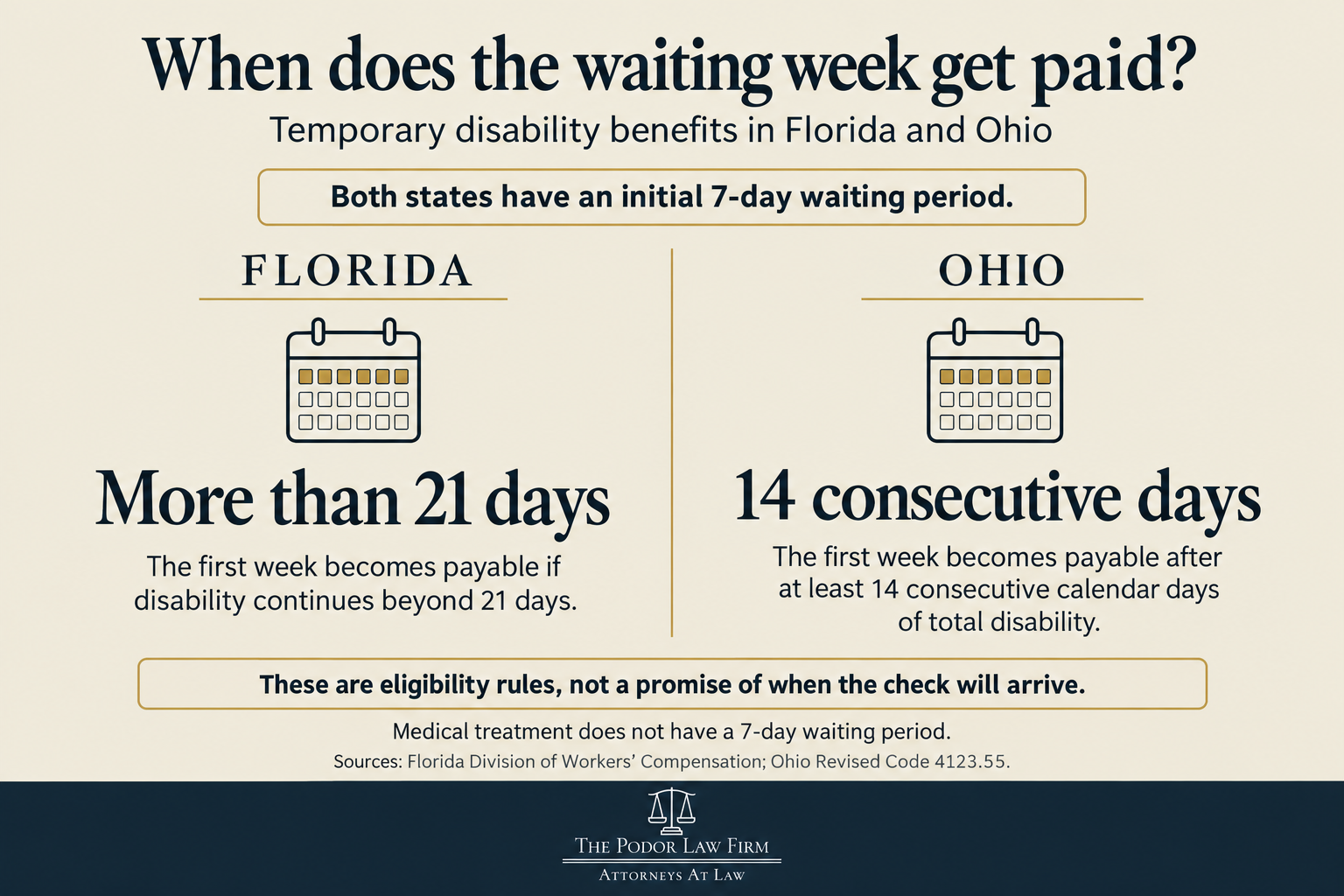
You could be out of work for more than a week and still be waiting for your first payment. In both Florida and Ohio, there is generally no wage payment for the first seven days of disability. If you remain disabled long enough, however, those days can become payable as well.
For Florida, your qualifying disability must last more than 21 days before the first seven days can be paid. If it lasts only ten days, you would ordinarily be paid for days eight through ten. In Ohio, the first week becomes payable once your total disability has lasted at least 14 consecutive calendar days.
Knowing which days can be paid helps you work out what you’re owed, but you still need to know when the money will arrive. Florida’s guidance says you should receive the first check within 21 days after reporting the injury to your employer, although a dispute can delay it. In Ohio, both your claim and the compensation you’re requesting need approval before payment is released. Missing medical information or an applicable appeal period can mean a longer wait.
You can receive medical treatment during the waiting period. You don’t need to wait until the wage benefits begin.
Making sure your medical report covers the time you need off
Your doctor may tell you to stay home for another two weeks because you haven’t recovered enough to return. If the insurer only has the earlier report, though, it may still have the date when you were originally expected back. This can leave you waiting for a payment even while you’re following your doctor’s instructions. The person handling your claim needs the updated report to consider paying for the additional time.
The report should explain when you couldn’t work, what restrictions you had and how the injury affected the work you could do. Knowing that you attended an appointment doesn’t necessarily provide that information. Ohio’s MEDCO-14 work-ability report asks for the dates of your restrictions, the hours you can work and your expected return to full duty. Your provider can use another report if it contains the required information. A copy will let you compare what’s been reported with the instructions you received.
Reporting the accident to your employer also needs to happen promptly. In Florida, the usual reporting deadline is 30 days, although there are exceptions. After telling your employer, you’ll want to confirm that the insurer or administrator actually received the claim. If a Florida employer refuses to report it, you can contact the insurer yourself or the state’s Employee Assistance and Ombudsman Office for help.
An employer may instead tell you that you’re a contractor and don’t have coverage. The fact that you receive a 1099 doesn’t settle that question by itself. Whether you’re considered an employee depends on the working arrangement, which we explain in our article on workers’ compensation for independent contractors.
Will the money come through your employer?
For most insured employers in Florida, the workers’ compensation insurer sends the benefit payment. In Ohio, the Bureau of Workers’ Compensation pays state-funded claims. A self-insured employer handles its own obligations.
You might still see your usual payroll deposit while you’re away. Ohio allows an employer to continue your salary instead of temporary total compensation for the same period. But a regular deposit could also mean that sick leave or vacation days are being used. You’ll want to find out how you’re being paid before assuming those days will still be available when you return.
If leave has been used, keep the pay records showing it. Whether the leave can be restored or coordinated with your benefits depends on the applicable rules and your employer’s policy or contract. Approved medical expenses are handled separately from wage payments; our guide to how workers’ compensation works explains how treatment and lost wages are covered.
What if you can work, but can’t do your usual hours?
You may be ready to work four hours a day before you’re ready to go back to eight. If working fewer hours leaves you earning less because of the injury, you may still qualify for some wage benefits during that time.
In Florida, temporary partial disability may be available when injury-related restrictions leave you unable to earn at least 80% of your pre-injury wages. The 80% figure helps determine whether you qualify; it isn’t the percentage of your salary you’ll receive. Ohio uses its own rules for wage-loss benefits.
The duties matter as much as the hours. A job described as desk work could still require you to lift deliveries, even if your doctor has said you shouldn’t lift. Giving your doctor the actual job duties helps them decide whether you can do that work. Refusing suitable work can affect your benefits. If your employer has no work within your restrictions, that should be documented for the person deciding what benefits you can receive.
You may also hear your doctor say you’ve reached maximum medical improvement. This means further significant recovery isn’t expected. It doesn’t necessarily mean you feel well or no longer have pain, but your temporary payments may end or change at that point. A lasting impairment may qualify for a different benefit, so the question becomes what benefits are available for the condition you still have.
Being paid while you recover doesn’t guarantee that your job will be held open. Florida prohibits retaliation for seeking workers’ compensation, but its workers’ compensation law doesn’t require an employer to keep the position open. Other employment laws may give you protection, depending on your situation.
If you’re still waiting for money or the amount is wrong
An accepted claim can leave you with questions about your pay. You may have missed more days than the approval covers, or the wages used to calculate the payment may still be disputed. Ask which dates have been approved and paid, and what is preventing payment for the remaining time. Having the explanation in writing lets you compare it with the medical reports and wage records you have.
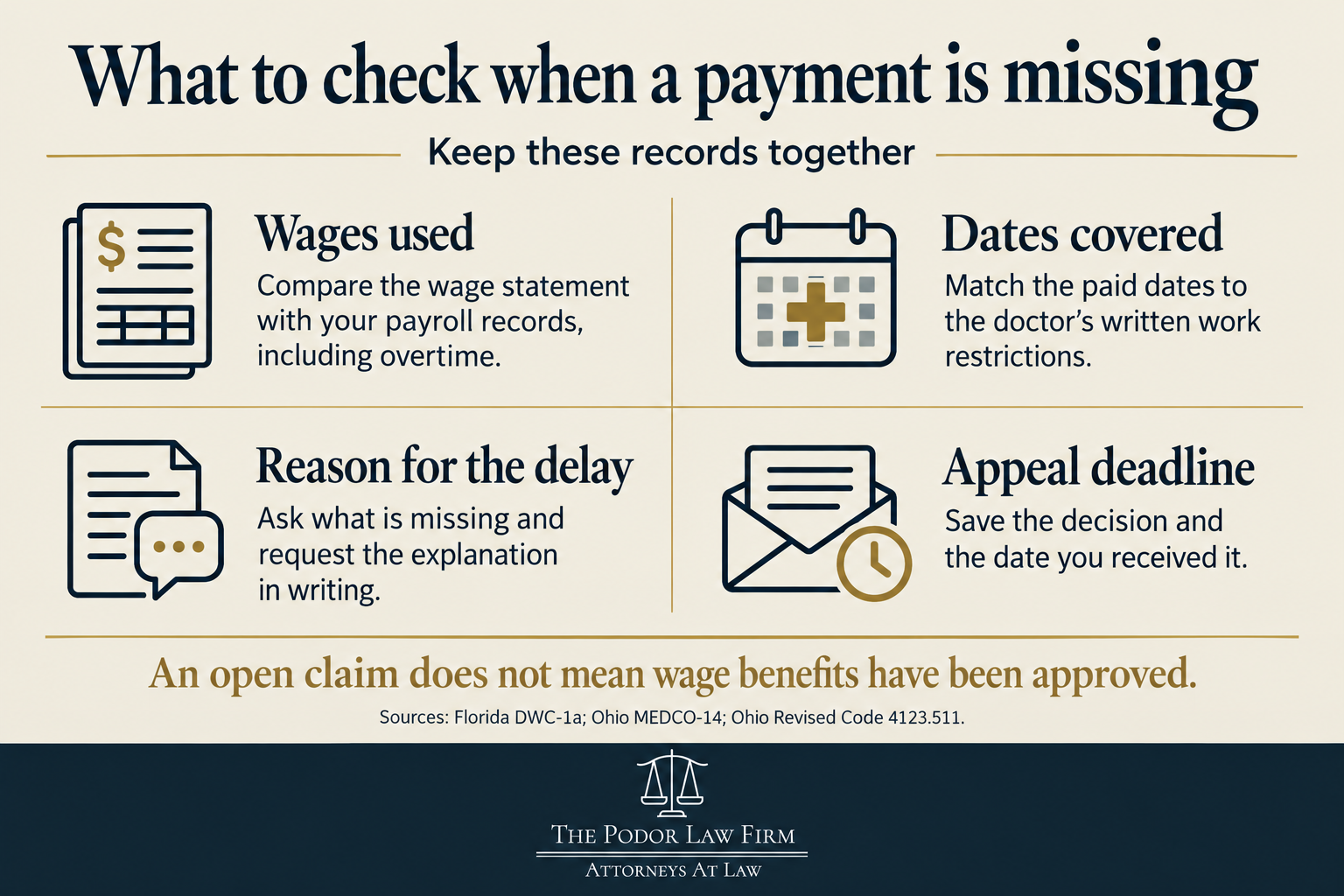
If a decision arrives and you disagree with it, the day you received it can matter. Ohio’s initial BWC orders generally give you 14 days from receipt to appeal. The letter may have been written days before it reached you, so keep the envelope or delivery record along with the decision.
In Florida, an unresolved dispute may require a Petition for Benefits. Its filing deadline depends on what has happened with your claim, and talking to the adjuster doesn’t, by itself, extend it. A workers’ compensation lawyer can review the decision and explain what needs to be filed to challenge it.
If someone outside your employment relationship caused the accident, you may have another claim as well. Our article on legal options after a slip and fall at work explains when you may have options beyond workers’ compensation.
You can request a free consultation with Podor Law if you’re dealing with a Florida or Ohio work injury and need help understanding your payments or coverage. Bring the claim decisions, medical restrictions and pay records you already have. We can review what you’ve received, what you’re still waiting for and the options available in your claim.
Sources
Florida Division of Workers’ Compensation. Benefits Available to Injured Workers.
Florida Division of Workers’ Compensation. Maximum Compensation Rate Table.
Florida Division of Workers’ Compensation. Injured Worker FAQs.
Florida Legislature. Florida Statutes Section 440.14 on calculating average weekly wages.
Florida Legislature. Florida Statutes Section 440.19 on time limits for petitions for benefits.
Ohio Legislature. Ohio Revised Code Section 4123.55 on the waiting period.
Ohio Legislature. Ohio Revised Code Section 4123.56 on temporary disability and wage-loss compensation.
Ohio Bureau of Workers’ Compensation. Compensation Rate Chart for 2011 through 2026.
Ohio Bureau of Workers’ Compensation. Salary Continuation Agreement (C-55).
Ohio Legislature. Ohio Revised Code Section 4123.511 on claim decisions and administrative appeals.
Florida Division of Workers’ Compensation. Wage Statement and Instructions (DWC-1a).
Ohio Bureau of Workers’ Compensation. Physician’s Report of Work Ability (MEDCO-14).